
Dishwashing Solutions for Hawker Centres: Handling High Turnover & Grease
- Kevin Tan
- May 5
- 8 min read
If you have ever eaten at a busy hawker centre in Singapore during peak lunch hour, you have probably seen it: trays returning faster than the dishwashing point can clear them, grease coated plates piling up, and humidity hanging thick in the air. Hawker centres are one of the most demanding F&B environments anywhere in the world, and a standard commercial dishwasher rarely survives the conditions intact. Many operators assume any commercial unit will do the job, only to discover months later that it cannot keep up with the grease, the volume, or the heat.

Why Hawker Centres Break Standard Dishwashers
Before we talk about the right machine, let us first understand why hawker centres are a completely different game.
Think of a standard café or restaurant dishwasher like a daily commuter car. Designed for predictable trips, controlled conditions, and steady use. A hawker centre dishwasher, by contrast, is more like an off road truck working a quarry site. The terrain is harsher, the load is heavier, and the demands never let up. Most commercial dishwashers are designed with a typical café, restaurant, or hotel in mind: predictable wash cycles, manageable grease, controlled ambient conditions. Hawker centres play by completely different rules.
So what are the real forces working against your machine in this environment?
Sustained peak load: lunch and dinner rushes can last 90 to 120 minutes with zero downtime, not 30 to 40 minutes like a typical restaurant.
Heavy grease loads: stalls cooking with high oil volumes (zi char, fried noodles, fried chicken) push grease onto every plate and bowl.
Mixed dishware: melamine bowls, ceramic plates, stainless steel trays, plastic spoons, and chopsticks all need different handling but go through the same wash.
Tropical humidity: ambient humidity in open air hawker centres regularly hits 80 to 90%, putting constant strain on machine electronics and ventilation.
Centralised dishwashing models: many hawker centres now operate centralised tray return systems, meaning one or two machines handle the load of 20 to 40 stalls.
A standard machine in this setting is not under equipped. It is being asked to do a job it was never designed for.
What Is a Hawker Centre Dishwasher?
Here is the simplest way to think about it. A hawker centre dishwasher is a heavy duty commercial dishwasher engineered to handle continuous high turnover wash cycles, heavy grease loads, mixed dishware materials, and humid tropical operating conditions typical of Singapore's hawker centres and food courts.
Think of it like the difference between a regular kitchen knife and a butcher's cleaver. Both are knives, but only one is built for the heavy duty work. Unlike café or boutique restaurant machines, these units prioritise three things:
Throughput durability: sustained 60 to 120+ racks per hour performance during peak windows.
Grease tolerance: wash systems and filtration designed to handle heavy oily residue without clogging.
Material compatibility: wash temperatures and detergent dosing calibrated for melamine, ceramic, and stainless steel in the same load.
In most cases, the right answer is a door type (passthrough/hood type) machine or, for the busiest centres, a conveyor/flight type machine sized for centralised tray return.
The Four Forces That Define a Hawker Centre Wash
So what exactly is your machine fighting every shift? Before choosing equipment, you have to understand the four forces that shape every wash cycle in this environment.
1. Grease The Number One Machine Killer
Think of grease in a dishwasher like cholesterol in arteries. It builds up slowly, blocks the flow, and eventually causes serious damage if left unchecked. Grease is the silent assassin of hawker dishwashers. It coats wash arms, clogs filters, and degrades pump components faster than any other single factor.
Symptoms of a grease overwhelmed machine:
Streaky residue on supposedly clean plates.
Wash arms spinning weakly or unevenly.
Detergent consumption climbing month over month.
Frequent service calls for clogged drain pumps.
A heavy duty commercial dishwasher built for hawker conditions will include:
Multi stage filtration with easily removable scrap baskets.
High temperature pre rinse cycles to emulsify grease before the main wash.
Robust wash pumps rated for continuous oily water duty.
Larger sumps that don't saturate with grease during peak hours.
If grease management is a daily struggle, the right detergent and rinse aid programme makes a huge difference too. We cover the chemistry behind effective commercial wash cycles separately.

2. High Turnover The Endurance Test
Think of hawker centre dishwashing like running a marathon at sprint pace, every single day. Hawker centres do not have "average" wash volumes. They have peaks that punish equipment for two hours straight, then settle into a steady simmer.
A typical hawker centre dishwashing point may handle:
600 to 1,200+ trays per peak hour in a centralised tray return setup.
8 to 14 hours of continuous operation per day.
Six to seven operating days per week, often with no full rest day for the machine.
This is why hawker dishwashers need to be sized for peak load, not average daily volume, and built with industrial grade pumps, motors, and heating elements that can withstand the duty cycle.
3. Mixed Dishware The Compatibility Challenge
Think of a hawker centre wash load like a school cafeteria tray, plastic, metal, glass, ceramic, all jumbled together, each with its own quirks. A hawker centre wash load is rarely consistent. In the same rack, you might have:
Melamine bowls that warp at temperatures above 80°C.
Ceramic plates that need higher wash temperatures to fully de grease.
Stainless steel trays that streak easily without proper rinse aid.
Plastic cutlery and chopsticks that float, rattle, and trap water.
The right machine handles this through:
Adjustable wash and rinse temperatures to balance melamine safety with grease removal.
Specialised racks and inserts for cutlery and small items.
Consistent rinse aid dosing to prevent streaking on stainless steel and ceramic.
4. Humidity and Heat The Hidden Stressor
Think of humidity in an open air hawker centre like rust on metal. It works slowly, quietly, but relentlessly. Open air or semi open hawker centres operate in ambient conditions that would destroy most office equipment. For dishwashers, this means:
Steam compounding with already humid air, creating fog and condensation issues.
Faster electronic degradation if the machine is not built for humid tropical environments.
Operator fatigue that affects consistency in pre rinsing and loading.
Look for machines with steam condensers, sealed control panels, and stainless steel construction throughout to survive this environment for years rather than months.
The Right Machine Categories for Hawker Centres
Not every commercial dishwasher fits this brief. Here are the three categories that actually work.
Door Type (Passthrough / Hood Type) Dishwashers
Think of these as the reliable pickup truck of the dishwasher world. Tough, versatile, and built to take a beating without breaking down. The workhorse of mid volume hawker centres and food courts. Handles 50 to 80 racks per hour, fits into a standard centralised dishwashing layout, and runs on three phase power for sustained heavy duty operation.
Best for:
Small to mid sized hawker centres with 15 to 25 stalls.
Centralised tray return points with steady, not extreme, peaks.
Operations that need a balance of footprint, speed, and durability.
For a deeper look at this category, our breakdown of door type and passthrough hood systems covers specifications and use cases.
Conveyor / Flight Type Dishwashers
Think of these as the freight train of the dishwasher world. Built for continuous heavy loads, moving wares through one zone to the next without ever stopping. The heavy artillery for the busiest hawker centres. Handles 150 to 300+ racks per hour, with wares moving continuously through pre wash, wash, rinse, and drying zones.
Best for:
Large hawker centres with 30+ stalls and centralised wash operations.
Food courts in malls with sustained peak hours.
Operations where two or more staff load and unload continuously.
These machines are a serious investment, but in the right setting, they pay back fast through labour and throughput gains.
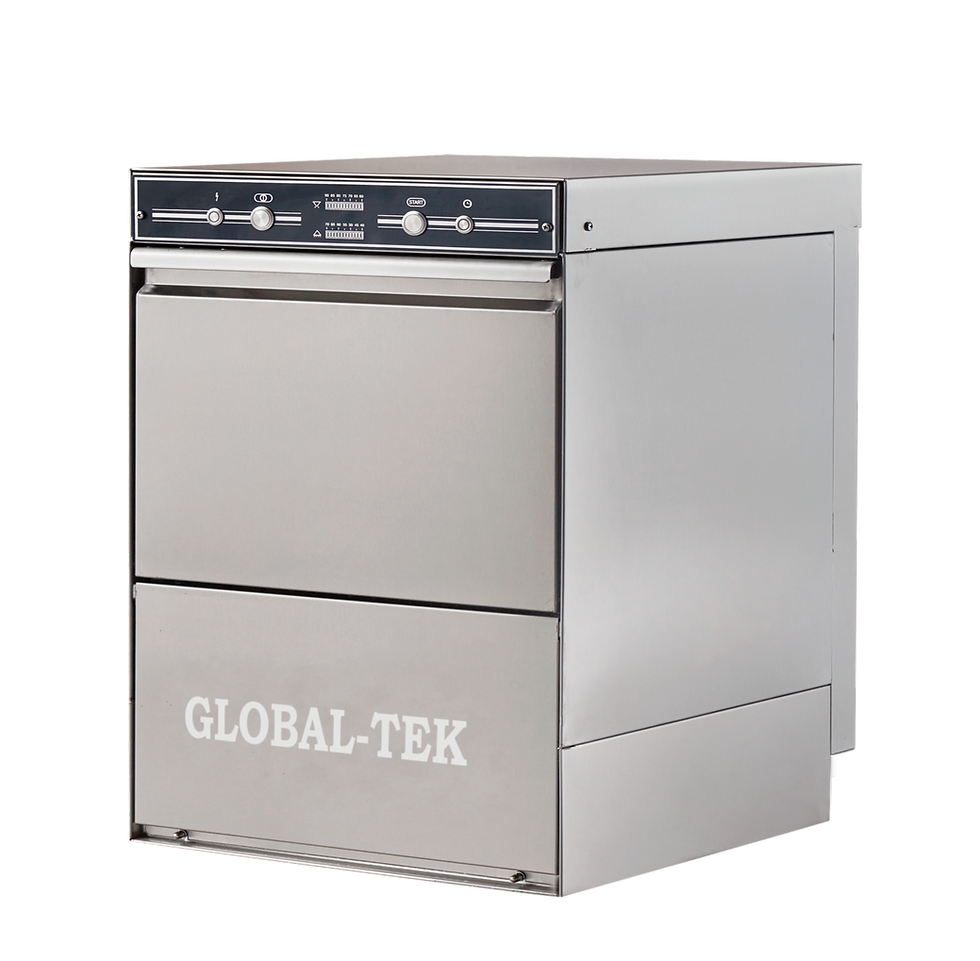
Heavy Duty Door Type with Booster Heater
Think of the booster heater like a turbocharger for your dishwasher. It gives the final rinse the power it needs to actually sanitise and degrease at the same time. A door type machine equipped with an internal booster heater is often the smartest choice for hawker centres dealing with heavy grease. The booster lifts rinse water to 82°C+ consistently, sanitising properly while emulsifying remaining oil residue.
This is often the sweet spot between cost and capability for centralised tray return setups in Singapore.
Real World Example: A Centralised Hawker Centre in Singapore
Numbers tell the clearest story, so let us walk through one together.
Consider a hawker centre in central Singapore with 22 stalls, running lunch and dinner peaks plus a steady late night supper trade. The centralised dishwashing point handles all tray, plate, and bowl returns. The original setup used an entry level commercial undercounter machine, which simply could not cope with the conditions.
Here is what changed after switching to a heavy duty door type passthrough dishwasher with booster heater, multi stage filtration, and dedicated cutlery racks:
Metric | Before (Entry Level Undercounter) | After (Heavy Duty Door Type) |
Peak Throughput | Could not keep up, trays piled on floor | 80 racks per hour consistently |
Re Wash Rate | 25 to 30% (heavy grease residue) | Under 5% |
Detergent Spend | 40% above industry benchmark | Dropped by 30% |
Machine Lifespan | Pump motor failed within 14 months | Less than 1% downtime over 24 months |
Payback Period | — | Under 9 months |
The total upgrade paid for itself within nine months and removed the operational risk of a peak hour machine failure. That is the quiet power of choosing equipment built for the environment, not just for the volume.
Strategic Insight: Hawker Centres Are a Specialist Application
Here is something many hawker centre operators miss. The biggest mistake is treating dishwashing as a generic equipment purchase. It is not.
Think of hawker centre dishwashing like a Formula 1 pit stop. The conditions are extreme, the timing is brutal, and every component has to be specialist grade. This is one of the most demanding F&B environments in Singapore, and it deserves a specialist's approach.
Smart Singapore F&B equipment decisions in hawker settings come down to three principles:
Spec for grease, not just for volume. A machine that handles 100 racks/hour but clogs on grease is useless.
Build for tropical humidity. Electronics and seals matter as much as pumps and heaters.
Plan for the centralised model. Most modern hawker centres now consolidate dishwashing, your machine has to scale with that reality.
For a broader look at how machines fit different F&B formats, our hub article on F&B dishwasher solutions across cafés, bars, and restaurants lays out the full landscape.
Quick Checklist: Is Your Hawker Centre Dishwasher Up to the Job?
We know every operation is different, so instead of giving you a blanket recommendation, here is a simple diagnostic you can run through for your current setup:
Does your machine maintain peak throughput (50+ racks/hour) during the full lunch rush?
Is the re wash rate consistently under 10%?
Are wash temperatures hitting 60 to 65°C, with a 82°C+ sanitising rinse?
Can the filtration handle heavy grease without clogging within a single shift?
Is the unit rated for continuous duty (8+ hours/day, 6 to 7 days/week)?
Are electronics sealed against humidity and steam?
Can the machine accommodate melamine, ceramic, and stainless together without compromising results?
If you answered "no" to two or more, your machine is likely under spec'd for hawker centre conditions, and the cost is showing up in re washes, breakdowns, or chemical overuse.
Pick the Workhorse, Not the Compromise
Hawker centres are the backbone of Singapore's F&B culture, and the dishwashing point is the unsung backbone of every hawker centre. When the machine fails, every stall feels it within minutes.
Think of choosing the right hawker centre dishwasher like picking the right pair of work boots. The cheap ones may look fine on day one, but only the proper ones will still be standing after a year of daily punishment. The right machine is not the cheapest one that fits the space. It is the one built specifically for grease, humidity, and relentless turnover, and it pays for itself in uptime, throughput, and reduced operating costs over a five to seven year service life.
Investing in the right hawker centre dishwasher today is not just about getting through service. It is about building a kitchen point that is more efficient, more reliable, and more sustainable for the years ahead. And if you would like a hand thinking through the right setup for your hawker centre, food court, or tray return system, we are always happy to help you find the right fit.


Comments